


How VR & Mixed-Reality Flight Simulators Are Revolutionizing Pilot Training in Pakistan
Published by FSDC Aerosolutions Engineering | May 13, 2026
What is the difference between VR and Mixed Reality flight simulators? While Virtual Reality (VR) immerses a pilot entirely in a computer-generated world, Mixed Reality (MR) blends the physical and digital environments. In an MR simulator, pilots wear a high-resolution headset with passthrough cameras. This allows them to look out the virtual window to see the synthetic terrain, but look down to see their actual hands operating real, physical cockpit instruments. This tactile feedback is essential for muscle memory and procedural training.
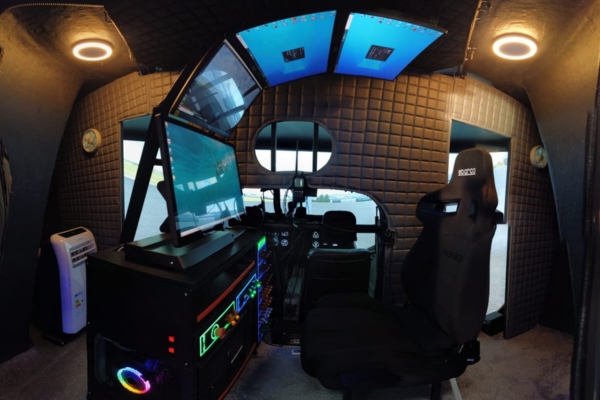
For decades, the benchmark for advanced aviation training has been the traditional dome-based visual system. While highly effective, these projection systems require massive physical footprints, complex multi-projector alignment, and significant power consumption. As aviation training demands grow in regions like Pakistan and the broader Middle East, the push for scalable, high-fidelity, and cost-effective alternatives has accelerated.
Enter the era of Virtual Reality (VR) and, more importantly, Mixed Reality (MR). By integrating commercial off-the-shelf XR headsets with custom-engineered physical cockpits, manufacturers like FSDC Aerosolutions are bridging the gap between desktop procedural trainers and heavy dome simulators. The AeroMix mixed-reality platform demonstrates how this technology is fundamentally changing the way pilots acquire and maintain skills.
The Technical Limitations of Pure Virtual Reality (VR)
To understand the value of Mixed Reality, we must first address the limitations of pure Virtual Reality in aviation training. In a pure VR setup, the user is completely cut off from the physical world. While this provides excellent immersion for visual flight rules (VFR) navigation, it creates significant challenges for instrument flight rules (IFR) and procedural training.
When a pilot in pure VR reaches for a flaps lever or an autopilot dial, they are reaching for empty space. They must rely on virtual hands and floating UI elements to interact with the aircraft systems. In aviation, where muscle memory and tactile feedback are critical for emergency response, the inability to feel the distinct shape of a landing gear selector or the detent of a throttle quadrant is a severe pedagogical drawback.
The Mixed-Reality (MR) Breakthrough: Tactile Fidelity
Mixed Reality solves the tactile problem through high-fidelity visual passthrough. Advanced headsets utilize stereoscopic cameras mounted on the front of the visor. These cameras capture the physical environment—the real cockpit shell, the physical instruments, and the pilot's own hands—and blend it seamlessly with the computer-generated "out-the-window" (OTW) environment.
FSDC's AeroMix systems capitalize on this architecture. We manufacture 1:1 scale physical cockpit shells equipped with aerospace-grade switches, yokes, and pedals. When the pilot looks down, the headset masks out the virtual world, allowing the pilot to see and manipulate the real hardware. When they look up, the mask transitions to the virtual synthetic environment driven by the simulation engine.
Latency Reduction and Head-Tracking Precision
The success of any XR training system hinges on latency. If the visual feedback lags behind the pilot's head movement (motion-to-photon latency), it induces simulator sickness and destroys the training value. Modern MR architectures achieve sub-20 millisecond latency through predictive tracking algorithms and ultra-fast display refresh rates (typically 90Hz to 120Hz).
Inside the AeroMix platform, optical and inside-out tracking sensors continuously monitor the pilot's head position in six degrees of freedom (6-DOF). This ensures that parallax errors are minimized. If the pilot leans around a physical window pillar to look at the virtual runway, the perspective shifts accurately in real-time.
Multi-Crew Coordination in Mixed Reality
Crew Resource Management (CRM) is a critical component of commercial and military flight training. Historically, this was impossible in VR because pilots could not see each other. Mixed Reality transforms this dynamic.
Because the passthrough cameras capture the physical cockpit space, the Captain can physically see the First Officer sitting next to them. They can point to physical instruments, exchange visual cues, and coordinate actions just as they would in a real aircraft. This capability allows academies to deploy MR simulators for complex multi-crew scenarios that previously required multi-million-dollar full-flight simulators.
Integrating with the Instructor Operating Station (IOS)
The visual system is only one half of the training equation. The true power of a simulator lies in the instructor's ability to manipulate the environment. Every FSDC AeroMix and AeroSim Pro platform is coupled with a comprehensive Instructor Operating Station (IOS).
While the student is immersed in the MR headset, the instructor monitors their progress via the IOS telemetry dashboard. The instructor can inject real-time system faults (e.g., engine fires, hydraulic failures), alter weather conditions, and adjust time-of-day. Because the pilot is using a physical cockpit, their reaction to an engine fire involves reaching for the physical fire suppression handle, rather than clicking a virtual button.
Scalability for Aviation Academies in Pakistan
For aviation academies and defence operators in Pakistan and the broader region, the adoption of MR simulators offers unprecedented scalability. Traditional dome simulators require massive facility modifications, heavy HVAC infrastructure, and extensive maintenance.
In contrast, MR platforms like the AeroMix require significantly less physical space while delivering comparable visual field-of-view (FOV) and depth perception. This allows training centers to deploy multiple devices in the space previously occupied by a single legacy system, directly increasing student throughput and lowering the operational cost per training hour.
Conclusion: A Phased Approach to Synthetic Training
Virtual Reality initiated the conversation about compact immersive training, but Mixed Reality has delivered the practical solution. By combining physical, tactile cockpits with high-resolution synthetic visuals, FSDC Aerosolutions provides a training platform that respects the necessity of muscle memory while embracing modern display technology.
For more technical details on our MR architectures, explore our custom simulator services or access our capability profiles in the Downloads section.
Frequently Asked Questions
What is the difference between Virtual Reality (VR) and Mixed Reality (MR) in flight simulation?
Virtual Reality completely immerses the pilot in a digital environment, requiring virtual hands or controllers to interact with instruments. Mixed Reality (MR), on the other hand, utilizes high-resolution passthrough cameras on the headset. This allows the pilot to see and physically interact with real, tactile switches and controls in a physical cockpit shell, while the out-the-window view is generated virtually.
How does Mixed Reality improve multi-crew training?
MR enables Crew Resource Management (CRM) by allowing the pilot to see their co-pilot in the physical space alongside them. True spatial awareness inside the cockpit is maintained, which is critical for complex emergency procedures and multi-crew coordination.
Does MR cause simulator sickness?
Modern MR headsets mitigate simulator sickness by maintaining sub-20 millisecond motion-to-photon latency and high refresh rates (90Hz+). Additionally, seeing the static physical cockpit frame helps ground the pilot's vestibular system.

