
Event story · Istanbul
One airframe, two aircraft: IDEF 2025 and the dual-role simulator
Istanbul was our first exhibition outside Pakistan. We took one machine that could be a trainer aircraft in the morning and a helicopter in the afternoon — and a partnership model built for a market where the Super Mushshak already flies.
22–27 July 2025
Istanbul Expo Center, Türkiye
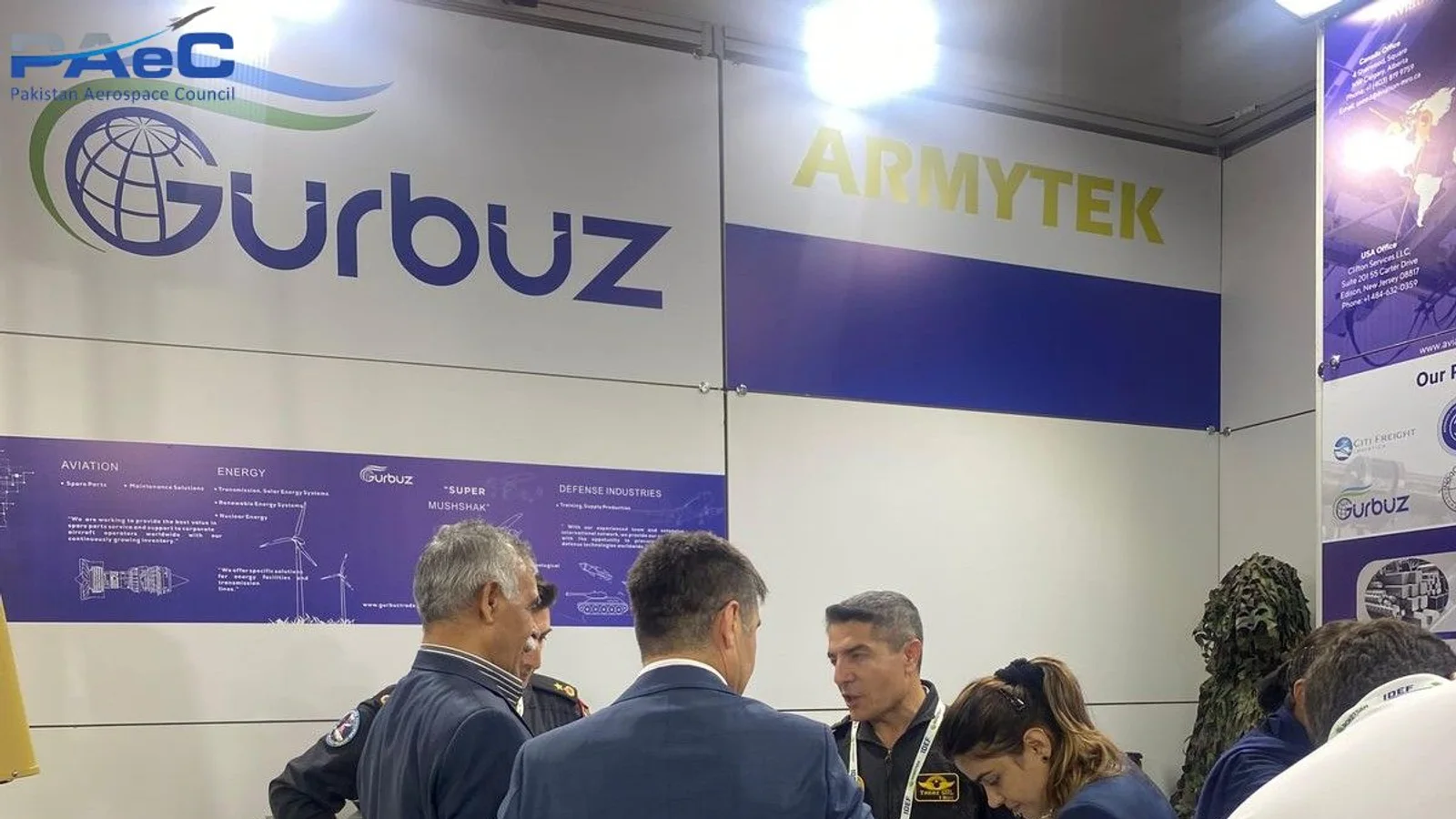
Hall 9, Stand A11 · Gürbüz Trade booth
AeroFusion Hybrid Infinity (VR Super Mushshak)
Gürbüz Trade · Aviation MRO
At IDEF 2025 — the 17th International Defence Industry Fair, held 22–27 July 2025 at the Istanbul Expo Center — FSDC Aerosolutions unveiled the AeroFusion Hybrid Infinity simulator configured as a VR Super Mushshak trainer, at Hall 9, Stand A11 inside the Gürbüz Trade booth with partner Aviation MRO. The system switches between fixed-wing and rotary-wing flight models in software on a compact electric 6-DOF motion base, and was covered by Halldale MS&T.
Why Istanbul, and why then
A first international show is not a marketing decision, it is a market decision. Türkiye made sense for one concrete reason: the Turkish Air Force operates a fleet of PAC Super Mushshak primary trainers. Where the aircraft flies, demand for a matched synthetic trainer follows — and we already had the flight data.
That is a very different sales conversation from a generic simulator pitch. We were not asking anyone to imagine how our device might map onto their fleet. We brought a simulator modelled on an aircraft already sitting on their flight line, and let instructor pilots fly it.
The engineering argument: one frame, two aircraft
The AeroFusion Hybrid Infinity exists to answer a question flight academies ask constantly: why do I need two devices? A school that trains fixed-wing primary students and also runs rotary-wing transition has traditionally needed two simulators, two footprints, two maintenance contracts and two sets of spares.
Hybrid Infinity puts both on one hardware frame. The physical platform — the electric 6-DOF base, the control loading channels, the visual system, the instructor station — stays constant. What changes is software:
- Flight model swaps between the fixed-wing and rotary-wing aircraft.
- Control loading profiles re-tune to the target type — stick and pedal forces for the aeroplane, cyclic centring and collective friction for the helicopter.
- Visual profile and cockpit behaviour follow the selected type.
- Motion cueing re-tunes to the handling characteristics of the aircraft currently loaded.
With the flip of a switch, the platform adapts its flight model, visuals and cockpit behaviour in real time — from fixed-wing to rotary-wing, on the same device.
— As reported by Halldale Group (MS&T), July 2025
| Element | Fixed-wing mode | Rotary-wing mode |
|---|---|---|
| Flight model | Super Mushshak / MFI-17 aerodynamics from flight-test data | Rotorcraft dynamics with collective and anti-torque behaviour |
| Control loading | Stick force per g, breakout, trim, buffet | Cyclic centring, collective friction, pedal forces, trim release |
| Motion cueing | Onset cues for rotation, stall, unusual attitude | Hover instability cues, vortex-ring onset, torque effects |
| Visual profile | Circuit, IFR and cross-country | Confined-area, low-level, hover reference points |
| Hardware | Unchanged — same 6-DOF base, same cockpit shell, same IOS | |
Why buyers care. Total cost of ownership on synthetic training is dominated by things nobody puts in the brochure: floor space, power, maintenance labour, spares inventory and instructor familiarisation. Halving the number of devices halves most of those lines. That was the entire commercial argument at IDEF, and it landed.
Six days, in order
Partnership announced
Global Defense Insight publishes that FSDC Aerosolutions, Gürbüz Trade and Aviation MRO will jointly present immersive flight-training solutions at IDEF 2025, naming Hall 9, Stand A11.
Doors open at the Istanbul Expo Center
IDEF 2025 opens for a six-day run. FSDC engineer Abdullah Sindhu posts from the stand during “final pre-show calibrations” — the unglamorous part of exhibiting that decides whether the week works.
The unveiling
FSDC publishes its own post unveiling the compact VR Super Mushshak configuration of the AeroFusion Hybrid Infinity, detailing 6-DOF motion, Varjo headset, control loading and a customised instructor operating station.
Turkish Air Force instructor pilots fly the device
Instructor pilots take the simulator through handling checks — the validation that matters most, because it comes from people who fly the actual aircraft.
Halldale MS&T feature
Halldale Group publishes “FSDC Aerosolutions Debuts Dual-Role Motion-based VR Simulator with Super Mushshak”, quoting FSDC’s chief design engineer on switching flight models, visual profiles and cockpit behaviour through software.
The partnership model was the other product
Exhibiting inside the Gürbüz Trade booth with Aviation MRO was deliberate. Defence and aerospace buyers do not evaluate a device in isolation; they evaluate whether it will still be supported in year seven. A foreign manufacturer with no local representation is a risk item on a procurement form regardless of how good the hardware is.
Arriving as part of a local structure — with a trade partner in-market and an MRO organisation attached — answers the sustainment question before it is asked. It also signals the direction of travel: representation, localisation and eventually co-development, rather than a one-off export sale.
What IDEF taught us
Versatility beats specification sheets. Visitors did not linger over the resolution of the headset. They lingered when we switched aircraft type in front of them and the cockpit forces changed. Demonstrable behaviour outperforms stated capability every time.
Compact is a feature, not a compromise. Several conversations turned on footprint — schools with a hangar bay to spare, not a purpose-built simulator hall. A device that fits where the customer actually has room is a device that gets bought.
Trade media still moves the needle. The Halldale MS&T feature reached procurement and training-standards readers we could never have met on the floor, and it remains the single most useful third-party reference from the show.
Related FSDC reading
- Mixed reality / VR / XR simulator engineering
- Rotary-wing simulators
- Fixed-wing simulators
- How 6-DOF motion improves training realism
- What an Instructor Operating Station does
Frequently asked questions
What did FSDC unveil at IDEF 2025?
The AeroFusion Hybrid Infinity simulator configured as a VR Super Mushshak trainer on a compact electric 6-DOF motion platform, with software switching between fixed-wing and rotary-wing flight models.
Where was the stand?
Hall 9, Stand A11 at the Istanbul Expo Center, inside the Gürbüz Trade booth alongside Aviation MRO.
What is a dual-role simulator?
A device that supports more than one aircraft category on a single hardware frame, with the flight model, control feel, visuals and cockpit behaviour switched in software.
Why does the Super Mushshak configuration matter in Türkiye?
Because the Turkish Air Force operates a fleet of PAC Super Mushshak primary trainers, creating direct demand for a matched, cost-effective synthetic trainer.
Can the same platform be configured for our aircraft?
Yes — custom simulator solutions are built around the customer’s aircraft data package. Talk to the engineering team.
Source register & coverage
IDEF 2025 was strongest on LinkedIn and in specialist trade media. Every claim above traces to one of the public references below.